A bright sunny day in August, fully charged by 10:30 in the morning, and the closest we’ve come to hitting our inverter limit of 12 kW. If the batteries had more capacity, or we were using more, I think we would have seen it max out.
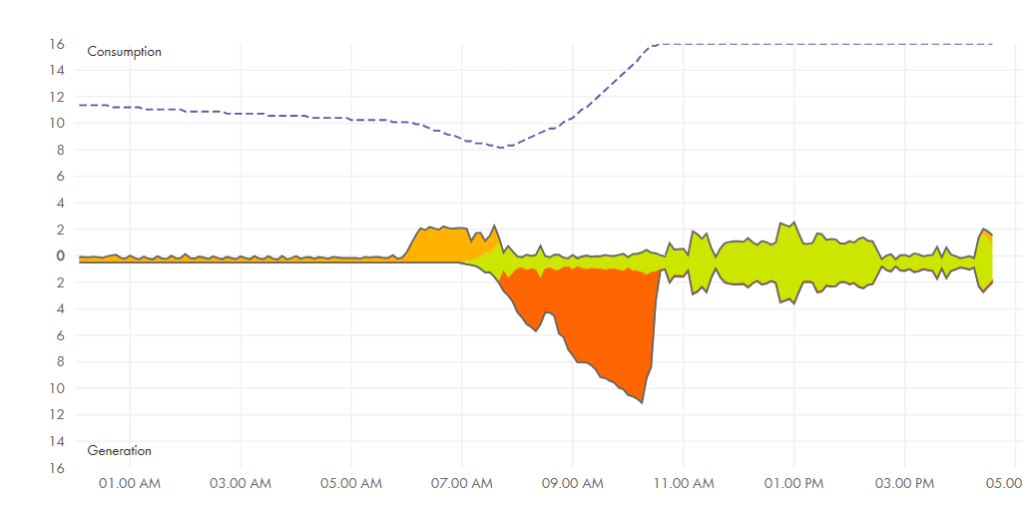
A sunny day in June (when the hot water was set to come on at 10:00) at 9:20 we got to 6.6 kW production before the battery was full.
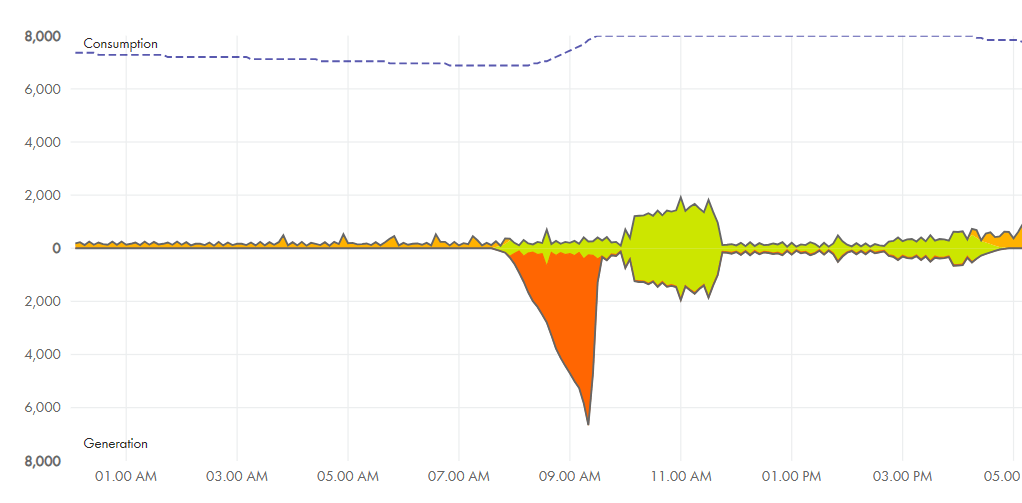
(Interesting improvement in production – in June at 9:20 we got 6.6kW, in August we got 7.5 kW, and we started making power almost half an hour earlier – nice!)
But these are atypical days for winter. Most good days look a lot like the following:
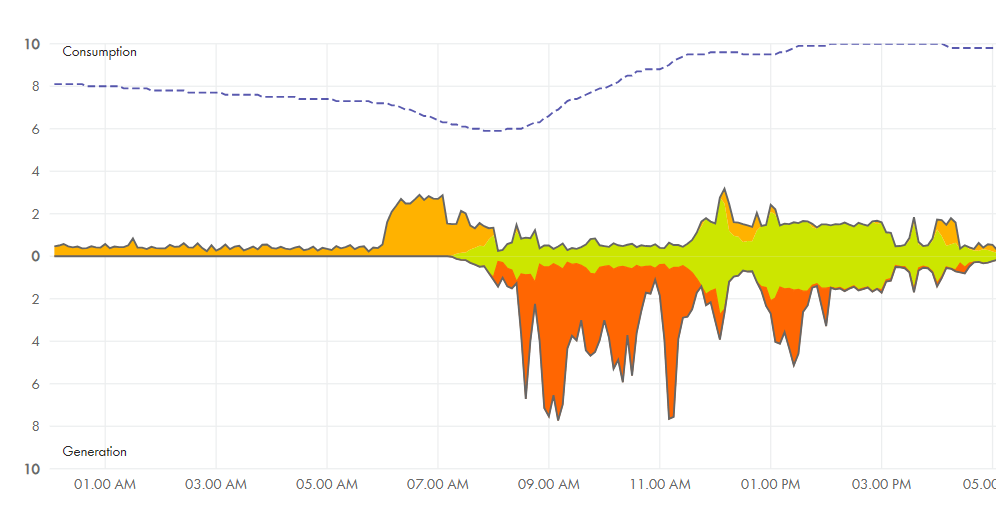
Clouds of various thicknesses coming and going, and we don’t get close to the inverter limit. With very light cover, we get good power production, but with heavier clouds we get very little.
We have NEVER maxed out the inverters.
If we had fewer solar panels (matched to inverter), we would produce less power, one third less. And that would be a problem.
If we had larger inverters, it would make no difference at all – we would not produce any more useable power.
And today, with the sun out, we were fully charged by 10:30. Even with a fully depleted battery, another hour or two would have seen it charged, and that’s even if the inverters were maxed out. So arguably, our inverters are too large!
But, to get STCs, the panel capacity can only be 33% more than the inverter capacity, and many inverters seem to say that’s about the max they can handle. So we got the maximum solar panels we could put on the inverters (and filled up the shed roof!). Absolutely right for winter.
In summer, we will have a lot more load – we will be using the RCAC so that will challenge the system more. if you said 8 hours x 3 kWhr (assuming a reasonable load factor) that’s 24 kWhr, or around 2 hours of maxed out inverter capacity. It really doesn’t change the equation. Larger inverters just wouldn’t be useful.
Of course, if we were connected to the grid, we could export up to the limit, but given that much of the time you’re producing well below the limit, it doesn’t really make a whole lot of sense. If we had larger inverters, we’d still install more panels to match!
So investing money in larger inverters doesn’t make a lot of sense (once you’ve got enough to meet your instantaneous power requirements). Just load up the solar panels to the max.
 Off Grid Living - Building the Dream